Thursday, February 9, 2012

Let's (not) talk about sex

If stereotypical Asian parents drove cars like they doled out sex advice, you’d be experiencing some serious whiplash.

“Sex just isn’t talked about. It’s shameful. And then there’s all this pressure to have children, and lots of children,” said Katherine, a 39 year-old Chinese American.

This typical “abstinence until it’s time to get married and have lots of children" policy can send a potentially sexually active young adult into a tailspin.

New studies have shown that due to unique stigmas and a lack of communication on sexual health and sexual education in the home, Asian Pacific Islander Americans have lower rates of condom use, lower rates of HIV testing and, in some groups, high teenage pregnancy rates.

While many American adolescents have to suffer through the “sex talk” with their parents, most Asian American families avoid the subject entirely, and API youths have to rely on the public school system, friends, books or movies for their sexual education. Discussing sex is an extremely personal topic, and infused with taboo and assumptions. Many parents fear that even bringing up the topic of sex will actually encourage their children to become sexually active, even though a study by the University of Washington found that students who received comprehensive sex education are half as likely to become teen parents as those who get none or abstinence-only sex education.

According to the National Asian Women’s Healthy Organization, more than half of Asian American women are uncomfortable talking about sexual and reproductive health with their mothers, and even more so with the male figures in the family.

“In my household, sex was hardly ever brought up,” said Justin, a 31-year-old Filipino American. “It was assumed that I came out of the ether, basically and that’s how it was.” But at the same time, living in America and being surrounded by American media, Justin was inundated with sexual images and stories. His mom’s solution? “Cover your eyes until I say when!”

All of this silence and trusting that other people will do the important job of educating young people about sexual health and the risks involved with sexual activity, has resulted in some surprising figures. The model minority myth has furthered the assumption that most API youths are not sexually active — they’re too busy studying and trying to get into a good college. That’s true to some extent. Compared to the national average, female API high school students are less likely to have had intercourse, and they lose their virginity at a later age, according to a study in the Journal of Adolescent Health. But, API youth were significantly less likely to use condoms at first intercourse than all other ethnic groups, according to a 2006 study by the National Longitudinal Study of Adolescent Health (known as Add Health).

While Asian Americans may have lower rates of HIV and other sexually transmitted diseases than other racial and ethnic groups, HIV infection is growing at the fastest rate among Asian Americans — 14.3 percent for women and 8.1 percent for men between 2001 and 2004, according to the Center for Disease Control.

Advocates for Youth, a national nonprofit that helps young people make informed and responsible decisions about their sexual health, cites some cultural assets that APIs have that could set the right course for healthy, knowledgeable API youth, but those assets have to be utilized. A high level of parental involvement in their children’s lives in Asian families is a significant factor in helping youths to make the decision to not jump into sexual relationships too early. In a survey, API youth were more likely than any other youth to believe their parents would disapprove of them having sex. Fewer than 10 percent of young API women in the Add Health study who reported a high level of parental involvement reported having had intercourse.

Avoiding the subject with teens, or dropping vague but stern notions of disapproval that “boys are bad” may be as effective as stopping a moving train. But just stopping the train isn’t enough. Eventually, everyone needs to learn how to ride the train, and safely. That’s where Asian parents leave their comfort zone and leave it up to others to educate their children. Studies show that young API women have a high level of confidence about themselves, enough to refrain from sexual activity. An important step is using that self-confidence to apply it to healthy sexual behaviors, such as contraception and reproductive health care.

Thirty-three year old Anna said that situation exactly describes her sexual health experiences. “I felt comfortable enough with my own decisions that I wasn’t ready for sex in high school. But then when I was ready, I definitely could’ve been more responsible with my choices in using contraception and practicing good reproductive health,” she said. “The sex ed classes in high school didn’t make much of an impression on me — not as much as a close personal conversation with someone close to me would have.”

Economic and social barriers can have just as much impact, with parents working multiple jobs, or immigrants and refugees lacking insurance and a comprehensive support network.

Older siblings sometimes step in to fill that role of educator. “In 4th grade, my brother and sister broke into my dad’s porn stash, and they forced me to watch this movie with them so I knew,” says Justin. “I resisted and didn’t want anything to do with it, but my siblings were like, ‘this isn’t that big of a deal, so just get over it.’ They were my guides, because my parents were too busy keeping the family going.”

For more information, go to www.advocatesforyouth.org or www.plannedparenthood.org/ppgnw.


The original version of this story was published in the International Examiner

Tuesday, January 17, 2012

A Green Year of the Dragon


Lunar New Year is just around the corner--and it's the year of the dragon! This brings a special oooooh factor to the annual festivities. The dragon is the zodiac symbol of power. Most of the dragons I know have big, sparkling personalities, or convey a quiet strength that you need to respect.

In honor of Lunar New Year, I've offered some tips on how to go green with your New Year's celebration:
  • Reuse those hong bao. The little red envelopes of money you receive from your parents and relatives shouldn't be thrown out--they're too pretty to not reuse. As a general safe rule, if you're a married adult, you should give out hong bao to kids at the celebration. Most adults also receive hong bao from their parents and grandparents (since we're always kids in their mind). $20-50 is considered polite if you can swing it.
  • Spend your money wisely. Lunar New Year is usually a time when younger folks find themselves flush with cash. Encourage smart spending, rather than sending it down the tubes by buying some new tops at H&M. Consider energy efficiency upgrades--they'll save you money! Start a little fund to trade in a clunker for a hybrid. And there's always the college fund.
  • Winter is the time for citrus! When giving oranges, go organic. They may be a bit more expensive but they're so much juicier and sweeter.
  • When doing your New Year's cleaning, use green cleaners wherever possible. They're easy to make, and you won't expose your guests or your family to noxious toxic fumes. Great recipes available at Women's Voices for the Earth's website.
  • If you're planning for a whole fish or seafood at your New Year's feast, find out which species aren't in danger of being overfished at the Monterey Bay Aquarium's website.
  • So you need to look spiffy and wear something new for New Year's. But do you really need another new outfit? Reach out to a friend whose style you admire (and who's the same size as you) and borrow and share clothes. Clothing swaps are a great way to refresh your wardrobe all year round!
  • Make your own New Year's cards. You'll be reviving an old world tradition, and the extra care and thought will be much appreciated.
  • Ok, I really didn't think there was such a thing as green fireworks, but there is! Check this out. I can't really vouch for how green they are, but no matter what fireworks you use, be sure to clean up wrappers so they don't get stuck in gutters and eventually get washed into storm sewers and into bodies of water. Or, opt for a quieter New Year's--the birds and your neighbors will appreciate it!

I hope these tips inspire some of you to go green with your New Year's celebration! 新年快乐!

Wednesday, September 21, 2011

Is fishing making you sick? A look at the Duwamish


Most Seattleites can rattle off the city’s famous, iconic waterways — Elliott Bay, Lake Washington, Lake Union … but asking about Seattle’s hometown river, and how to get there, is a head-scratching exercise. The fact is that there is a reason the Duwamish River isn’t a favorite recreation destination. Years of neglect and its location right next to heavy industrial areas in South Seattle have resulted in high levels of pollution and lost natural areas. So much so, that the federal government has designated the Duwamish a Superfund site.

The neighborhoods surrounding the Duwamish River are largely low-income, diverse communities burdened with unusually high exposures to air, land and water pollution and health stressors such as lack of access to healthy food and green/open space for physical activity. The area has King County’s highest asthma hospitalization rate and ranks among Seattle’s highest diabetes rates.

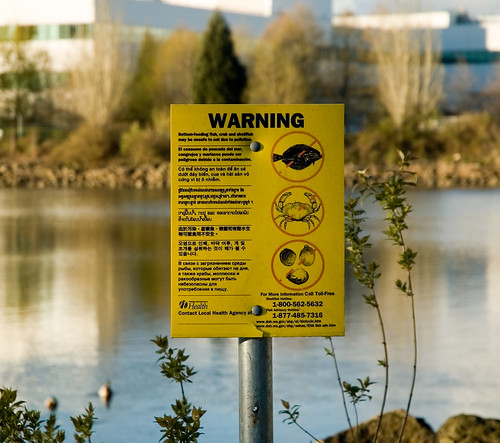
Despite the heavy pollution, seafood and wildlife are still present in the area, including rockfish, perch, clams, Dungeness crab and salmon. Salmon are safer because they spend most of their lives in the ocean, but others are loaded with cancer-causing PCBs, arsenic and dioxin, chemicals that can be particularly harmful to pregnant women, nursing mothers and children. Although there are public health advisories against eating seafood from the Duwamish, an untold number of immigrants continue to fish and eat seafood from the river.

“We know that a lot of people who are fishing here are Asian Pacific Islanders and Hispanics, who fished in their home country and want to fish here. That’s why we want to raise awareness between the link between contamination and eating fish,” says Renee Dagseth community involvement coordinator with the Environmental Protection Agency (EPA).

That’s one of the reasons why the EPA, the Washington Department of Health and the Duwamish River Cleanup Coalition puts on the Duwamish River Festival every year, as a way to both educate the community on the risks of eating contaminated seafood, and demonstrate cleanup progress. This year, the Aug. 27 festival saw over 1,000 people come and partake in the festivities. In addition to the festival, the state Department of Health posts warning signs in eight languages, including Vietnamese, Korean and Chinese.

Despite all of these efforts, people still regularly catch and eat seafood from the river. Some may not know or understand the pollution risk, while others may be low-income and simply can’t afford to buy seafood. Washington Department of Fish and Wildlife officials have revealed that some APIs may be subsistence fishing without a license, so are reluctant to admit the seafood they’ve caught. Distrust of government officials is also higher among immigrant communities.

Given that higher numbers of APIs and other minorities eat this contaminated seafood, there is a higher risk of these populations developing health problems associated with exposure to these toxic chemicals. Those health problems include increased risk of a number of cancers, including liver, kidney, prostate and breast cancer, linked with PCB exposure. The more contaminated seafood one eats, the greater these health risks become. Although the government doesn’t have any toxicology studies determining that these populations are in fact contaminated with higher levels of harmful, toxic chemicals, they’ve held several community meetings with Filipino, Vietnamese, Hmong and Lao groups, who have admitted to eating seafood from the river.

Many API populations eat larger amounts of seafood because it’s central to their native cuisine, and furthermore, APIs are more likely to eat the parts of the seafood that carry toxins — such as the liver and the head. Although government officials may not be able to tell people to not eat seafood, they are attempting to give them safer options. For example, removing the skin, fat and internal organs of the fish before cooking, not eating the guts of crabs, and limiting portion size and number of seafood servings per week.

“My family doesn’t fish here because we heard a lot of stuff about seafood at the Duwamish being polluted,” says Som Phimmachack, a volunteer with the Duwamish River Cleanup Coalition. “But if they get this place cleaned up to par, and Boeing keeps its word, I think people will come back, especially the elder Asians, because I think they’d really love to be able to fish here.”

That vision for a healthy Duwamish is something that the Duwamish River Cleanup Coalition would like to share with a larger majority of Seattleites, so that more citizens can take pride in Seattle’s hometown river, volunteer for the cause and take an active part in commenting on the EPA’s new cleanup plan.

“How much the river gets cleaned up will have a huge impact on whether it’s safe for people to start fishing again,” says the Duwamish River Cleanup Coalition’s BJ Cummings. “EPA needs to hear from people who now do or want to be able to fish in the river in the future, or the cleanup won’t go far enough to protect them.” To help the fishing communities participate and be heard, the Coalition hires multi-lingual interpreters and is launching the Healthy Communities Project to help identify and address health issues.

Want to get Involved?

Duwamish Valley Healthy Communities Project Kick-Off Event: November 10, 6 – 9 p.m. Location TBA. See www.duwamishcleanup.org for more information. To request a boat tour of the river, contact Alberto@duwamishcleanup.org.Multi-lingual tours are available to groups upon request.

Tuesday, July 12, 2011

Growing up Asian in a Small Town

The unique experiences of Asians and Pacific Islanders in small towns are occurring in increasing numbers, as more and more APIs move into suburbs and smaller towns, according to recent census figures. One’s isolation as one of the only minorities in town are compounded when compared to the close-knit communities of home countries, rich in the tastes, sounds and languages deeply embedded in API identity.
I grew up in a small town called Longmeadow, a white chapeled town in western Massachusetts withpre-Revolutionary War roots and a population of about 15,000. My parents moved there for the schools, after my dad got a job as a chemical engineer at Monsanto. They decided it was a good place to raise children — away from the crime of the big city — but also away from any strong notions of culture. We became one of the only Chinese families in the town.

I remember in 4th grade, when LeKeisha Blackwell, who lived in the neighboring city of Springfield, whispered to me during class, “What are you? I’m black, what are you? Write it down.”

I thought to myself, well, my skin isn’t black, it looked white to me. So I started to write down “white” on a slip of paper. She interrupted me.

“No, you aren’t white, like where are you from?”

“Oh … I’m Chinese.”

At this early age, I didn’t truly understand the concept of race and identity — I thought it was just a matter of skin color. It wasn’t until later on that I became more aware of how my ethnicity made me unique, and came to celebrate that uniqueness, rather than be ashamed of it.

Trying to “fit in” in middle and high school can be a painful process — when you’re a minority with a funny name, parents with accents and sometimes you come to school reeking of the tea eggs your mother just made, double that pain. And yet, thousands of APIs repeat this experience every day, rather than seeking refuge in large API-rich enclaves in big cities — the Chinatowns, Koreatowns, Little Saigons, etc.

According to 2010 Census figures, suburbs surrounding Seattle such as Kent, Tukwila, Redmond and Sammamish have had at least a 10 percent increase in the Asian population within ten years. Sammamish, formerly a small town, is said to be the fastest growing city in the state. Economic and education motivators continue to push APIs into newer, more culturally unfamiliar places.

Given these findings, what are the repercussions of these living choices, on one’s concept of race, identity and culture? And how do these changed notions of culture affect one’s relationships with the generations of elders?

Mary Nguyen grew up in the only Vietnamese family in Longview, Wash., which hugs the Washington-Oregon border along I-5. She says she faced fearful intimidation.

“Going through public schools, I didn’t want anyone to know I was Vietnamese,” said Nguyen. “People hated me because of my face. I remember knowing that it’d be just so much easier to be white … When you grow up in your small town, you’re not recognizing your family life in anything you’re seeing, including figures of authority.

Since then, Nguyen has utilized her experience into defending the rights and identities of others. She has led the National Asian Pacific American Women’s Forum (NAPAWF)’s Seattle Chapter and is a UFCW 21 labor community organizer.

“In college I sought out NAPAWF and that was the first time that I felt ok to really own up to my identity and relate to other API women,” said Nguyen.

Nguyen says that when she went to Vietnam for the first time, she was thrilled at the opportunity, but disappointed in her first month when her American accent conveyed the image of a traitorous, privileged American. “I thought, ‘where do I fit in?’” asked Nguyen. “I obviously don’t fit in in the States, and I didn’t “fit in” in Vietnam. I still struggle with that.”

Coming to terms with one’s own racial identity in relationship to others living in the U.S. shapes where we work, the relationships we choose, and where we live. Growing up in a small town that may have deeply ingrained prejudices toward minorities, a person can either be an outcast, seek bonds with other minorities and remain acutely aware of their ethnic identity, or, one could assimilate to American culture so much that their home culture doesn’t factor into their life choices much at all.

People arrive in the United States as refugees or as immigrants, and from a vast variety of cultures. As a result, Asian American concepts of race and identity are hugely diverse.

Growing up in a small town in Massachusetts, I wasn’t ignorant to how other young APIs were establishing themselves in the U.S. Every year, we made several trips to visit my grandparents, who lived in Queens and Manhattan’s Chinatown. Here, my parents reveled in the traditional Shanghaiese food, live fish and fresh produce and the ability to laugh and debate with their siblings and friends over dim sum and banquet dinners. While riding the elevators in my grandparents’ high rise apartment building, I would glance at the Chinese kids, speaking Cantonese fluently with their parents, decked out in Chinatown garb. I was always a bit jealous, knowing that they weren’t bound by the pressure to look like an Abercrombie model, and were fully at home in their community that so effectively imitated China.

But I can understand why my parents chose to raise my sisters and me in a small town community, despite the discrimination they faced from close-minded people. Vandalism, threatening phone calls, exclusion and name-calling are all scars on their and our lives, which will forever shape how we perceive America and ourselves.

Right now, towns all over the U.S. are in a transition. Hopefully, if towns become more and more diverse and open-minded, minorities will no longer feel the need to cover up their identities, but celebrate their culture with pride and conviction.

This article first appeared in the International Examiner, at http://www.iexaminer.org/news/small-town-life/

Images: A house in Longmeadow, Mass. and a shot of Manhattan, Chinatown. My two contrasting worlds.

Thursday, July 7, 2011

Do APIs Have Equal Access to Organic Food?


Last month, the USDA released an online food “desert” locater where one can view areas that are considered “food deserts”, based on the percentage of the population considered low-income, and the distance away from major supermarkets. Parts of West Seattle, Renton and Skyway are encompassed in big pink masses on the map. According to the site, one area in Renton has 2,174 people with low access to food. Among those with low access, 240 of them are considered low-income, 342 are children and 402 are seniors.

Food deserts are common in rural, urban and industrial areas, where high poverty rates combined with low access to healthy, affordable food can result in high obesity rates and poor nutrition. Eliminating food deserts through outreach to supermarket chains and community education is seen as just as much a social justice issue, as it is a health issue.

As negative health impacts are increasingly linked to exposure to pesticides used to grow conventionally-grown produce, urban areas that are flush with supermarkets are grappling with another issue. Is it possible to live in another kind of food desert — an organic food desert? And, could even moderate levels of poverty, or cultural notions of thrift, actually promote organic food deserts?

The choice to eat organic reflects a cultural rift in Seattle, and across the country. Those who are educated about health impacts, the environmental toll of nitrogen pollution in our waterways, and the fossil fuels that are burned to ship produce all over the world, can often afford to eat all organic.

For others, especially those in the Asian community, culture trumps all of these concerns. Upscale supermarkets like Whole Foods and Metropolitan market sell loads of (expensive) organic produce, but their selection of leafy green choy would leave any serious Chinese cook running for an Asian grocery.

Varieties of noodles, precisely mixed sauces, live fish and exotic mushrooms make up the dishes that are ingrained in our culture, and remind us of home and our families. All these ingredients are readily available to those living in my neighborhood in south Seattle, but are largely not organic.

To find out how many Asian groceries in my neighborhood offered organic produce, I did a little field research. I walked to my neighborhood market, Mekong Grocery on Rainier Ave. S., and asked an employee if any of the produce was organic. He said no, and that in the two years he’d worked there, he’d only seen organic baby bananas, once. I then went over to the new Othello Public Market on MLK and Othello. They have a diverse selection of produce for Latino and Asian communities, but nothing was organic.

“Our number one priority is to keep produce as accessible as possible,” said Mateo Monda, the market manager. Often organic produce is too expensive if they want to move it quickly, explains Mondo. Othello Public Market does plan to have local Washington produce, but not until another month or so. At Viet-Wah, the story wasn’t much different. The produce mostly comes from California, Mexico in the winter, with Washington fruit coming in the summer. It was not organic except for some tangerines, the produce manager told me. The barrier? Price.

So what can one do, if one wants to continue cooking Asian food, eat organic, and not spend a fortune? There are some options for gaining access to organic foods, that doesn’t mean trekking across town to an expensive upscale supermarket. For example:

• Cowpool. You and a group of people can organize to buy a whole, grass-fed cow from a local small-scale farm, rather than buying meat from an industrial factory farm. An eighth of a cow can be enough for a small family of three, is cheaper than buying organic meat from the supermarket, and you can request specific cuts, such as the tail, cheek, tongue and tripe. Cascade Range Beef is one company that handles cow shares. Harvest is available annually in spring.
• Farmer’s markets. There are now weekly farmer’s markets in nearly all neighborhoods in Seattle during the summer, including Columbia City, the Central District and West Seattle. Events, hours and locations are at www.seattlefarmersmarkets.org. Deals on organic produce can be found, depending on the item, season and vendor.

• Be selective. If you’d like to incorporate more organic foods into your family’s diet, focus on apples, bell peppers, berries, celery, cherries, grapes (imported), lettuce, nectarines, peaches, pears, potatoes, spinach, and strawberries, as they tend to be the ones that contain the highest levels of pesticides. Environmental Working Group has a full list of best and worst fruits and veggies at http://www.foodnews.org/fulllist.php.

• Community supported agriculture, or CSA is an alternative food network where individuals support local farming communities by purchasing a weekly or bi-weekly delivery or pick-up of organic produce, and sometimes dairy or meat. CSAs available in Seattle include Full Circle Farms, Tiny’s Organics and SPUD.

There isn’t conclusive science finding that those eating non-organic produce are far worse off than those who eat all organic. But, there have been studies finding that babies exposed to high levels of common pesticides in the womb have lower IQ scores than their peers. Pregnant women and parents of young children, especially, are choosing organic produce when it’s economically viable, as a precaution.

If you do live in a food desert, visit www.healthycornerstores.org for tips on how to build community support for healthier products at your nearest corner store. After you’ve developed a plan, reach out to your mayor and city council — they should want to work with you, especially if they have already introduced any special initiatives promoting healthy food, nutrition or wellness.

Above all, choice is precious. Those who have access to fresh, affordable produce that they can incorporate into their culture’s dishes are fortunate, to say the least. But if some are exposed to higher risks for types of cancers, reproductive problems, lower IQ and developmental disorders because of the food options they have, organic food deserts become an important problem to eliminate.

Sian Wu has been covering environment, human rights and politics for the International Examiner for seven years. As her day job, she works at a communications firm specializing in environment and public health issues. You can reach her at sianwu@yahoo.com.

This piece first appeared in the International Examiner, at http://www.iexaminer.org/news/food-nutrition-apis-equal-access/

Tuesday, January 11, 2011

Just an A? Why not A+? On "Why Chinese Mothers are Superior"


I have a Chinese mother--and I am a Chinese mother. Am I superior, as Amy Chua posits in her article in the Wall St. Journal, "Why Chinese Mothers are Superior?" Well, seeing as my son is only two, I can't attest to my parenting skills yet. Whenever my mom would complain that I wasn't studying hard enough and wouldn't get into a good college, (or even ask why I got an A, not an A+) I would compare myself to the absolute worst alternative. "Well, at least I'm not a teenage prostitute!" or "At least I'm not a drug addict lying in a ditch somewhere!" And I'm proud to say I'm still not either of those. Instead, I work at a nonprofit environmental communications firm, my husband of seven years works at a private school. We own our own home, have a cat and and an adorable bilingual toddler. I'm well-adjusted and get along with my parents and my sisters.

So did my mom's Chinese parenting technique work on me? I'd say yes. But there's no telling how I'd turn out if my childhood weren't punctuated with a healthy balance of Americanization.
I grew up in a typical middle class Chinese American household in Western Massachusetts, with three sisters. While my childhood did follow some of Amy Chua's prescription: private violin and piano lessons, outrage over a B, chastising over one's imperfect looks or manners and a clear, outlined expectation to be "The BEST" at something. But my parents also in large part let us sisters entertain ourselves. When we were young and the SATs weren't looming, we'd spend large parts of our days acting out elaborative imaginative scenarios with no toys, playing outside, climbing trees and collecting worms and rocks, swimming in lakes and the town pool, and taking home huge stacks of children's books from the library, which our parents dutifully read to us. When we grew older, we all ran cross country and track, meaning we'd come home, stinking of sneakers and locker room and huddle over the dinner table, and completely house chicken wings and Oreos as an after school snack. Never gaining any weight, though (we were Asian, after all). My dad was a big cheerleader of our sports although my mom never thought it was appropriate for a girl to exert herself so much.

My parents came from much more impoverished upbringings, and being in the U.S. offered a new hope for us American kids. Studying hard and doing well was a privilege for my dad--not everyone in his family had the option to study all the way through to their Ph.D. Others, like my uncle, had to quit school to provide for the family--with many hungry mouths to feed in post-World War China.

Chua's notion of working hard at something until you're so good at it it's fun is one route. But who's to say that the fun social skills one develops when they're a teenager aren't useful for their future success? After all, it was the popular, funny, eloquent, sociable kids who got elected class president, and that looks just as good if not better on a college application than principal second in the regional junior orchestra.

Another reason Chinese kids may be more successful that Chua doesn't mention is that these households are more likely to have a grandparent in the home. In Chinese households, living with one's elders is a cultural norm, whereas Americans are more likely to embrace retirement and nursing homes. When a child has a grandparent in the home, they get used to moving at a slower pace, and naturally develop a sense of patience. Grandparents can also help children with homework after school while parents are still working, and provide valuable perspective on frugality and hard work. Just the patience skill alone can be hugely valuable in elementary school education, when a student's achievement can grow leaps and bounds simply by sitting still, listening to the teacher and following instructions. Asian kids aren't necessarily smarter, they may just be better concentrators.

But these Asian kids who get great grades and go to good colleges, and get offered jobs at top companies, are they earning as much as their white counterparts? Studies say no. Maybe it's that deep-seated xenophobia that has afflicted Americans since the 19th century. Or maybe it's that these professionals are still a little socially awkward--after all those years of missing out on sleepovers and school plays.

I do agree with Chua that Chinese mothers are right in expecting strength from their children instead of fragility. If parents don't believe in their children, who will? But expecting strength also means seeing strength in a variety of different talents--not pushing skills that are seen as most likely to result in a high salary career. And maybe American parents would do well to expect the highest aptitude, rather than 'just good enough.' The A+ is there for a reason, after all.

I hope to raise my toddler with healthy balances of an American and Chinese upbringing. Hopefully if/when he first strikes that awful note on his half size violin, I'll know what to say--whether it's "great job" or "work harder!"

Wednesday, September 29, 2010

Shiny locks of formaldehyde? No thanks, Brazilian Blowout.


Stylists and customers have long suspected that the hair smoothing product popular with celebrities, the Brazilian Blowout, contains formaldehyde. The symptoms were too harsh to ignore--burning eyes, difficulty breathing, nose bleeds...

Now it's more than just a rumor. A toxicology lab in Portland, Ore. has confirmed results by analyzing two samples by Brazilian Blowout--the Brazilian Blowout Solution and the Acai Professional Smoothing Solution. Both products contain dangerously high levels of the suspected carcinogen formaldehyde—at 4.85 percent and 10.6 percent, respectively.

California-based Brazilian Blowout manufactures the products, which they claim to be “formaldehyde free.” The samples were taken to Oregon Health & Science University for testing after staff at a Portland salon reported difficulty breathing, nose bleeds and eye irritation when using the product as directed. The material safety data sheet (which should list hazardous chemicals) listed no formaldehyde. If a product contains more than 0.1% formaldehyde, the Occupational Safety and Health Administration requires the manufacturer to list it on the material safety data sheet.

I'm with Erin at Women's Voices for the Earth: “It’s incredibly disturbing that it’s taken salon workers getting sick to expose the fact that popular products contain a suspected carcinogen,” says Erin Switalski of Women’s Voices for the Earth, an environmental health advocacy group and co-founder of the National Healthy Nail Salon Alliance, a national network of health advocates and researchers working for safe salons. “Clearly, the nation’s laws regulating these products are failing workers and consumers alike.”

And, what's more, the Canadian government has been able to act swiftly and cease distribution of the product to Canadian salons. Their own tests revealed even higher levels of formaldehyde, at 12 percent.

Women’s Voices for the Earth, the National Healthy Salon Alliance and others have criticized the United States’ system for being ineffective in monitoring the safety of cosmetic products. Under current law, the FDA can’t require cosmetics companies to conduct safety tests, or even require product recalls. As a result, the marketplace is flooded with products that contain toxic chemicals. Workers and consumers are forced to rely on industry to self-police, which has not been effective enough. It is unknown at this time whether the Brazilian Blowout products will be recalled.

“Toxic beauty products have long jeopardized the health of salon workers,” says Anuja Mendiratta of the National Healthy Salon Alliance and the California Healthy Nail Salon Collaborative. “We regularly hear stories from women who are exposed to an unimaginable number of chemicals in their workplace and suffer a range of serious health impacts. I hope this is a wake-up call that something seriously wrong with our regulatory system, and we need to fix it at the federal level to assure worker and consumer health and safety.”

For the first time in 70 years, Congress is set to vote on the Safe Cosmetics Act of 2010, which would close the loopholes in the outdated federal law that allows chemicals to cause serious health impacts to salon workers and consumers.

The cost of the Brazilian Blowout treatment varies between $150 and $600. The Brazilian Blowout Solution and Acai Professional Smoothing Solution are just two products offered by the California company, and the only ones tested by OHSU. It is unknown whether other products, such as the Brazilian Blowout shampoo, conditioner and masque contain formaldehyde.

What do you think? Is it worth it to have smooth hair, if you're exposed to a carcinogen? Vote here!